Hot-foil stamping for luxury packaging — how the press, the foil, and the substrate decide the result
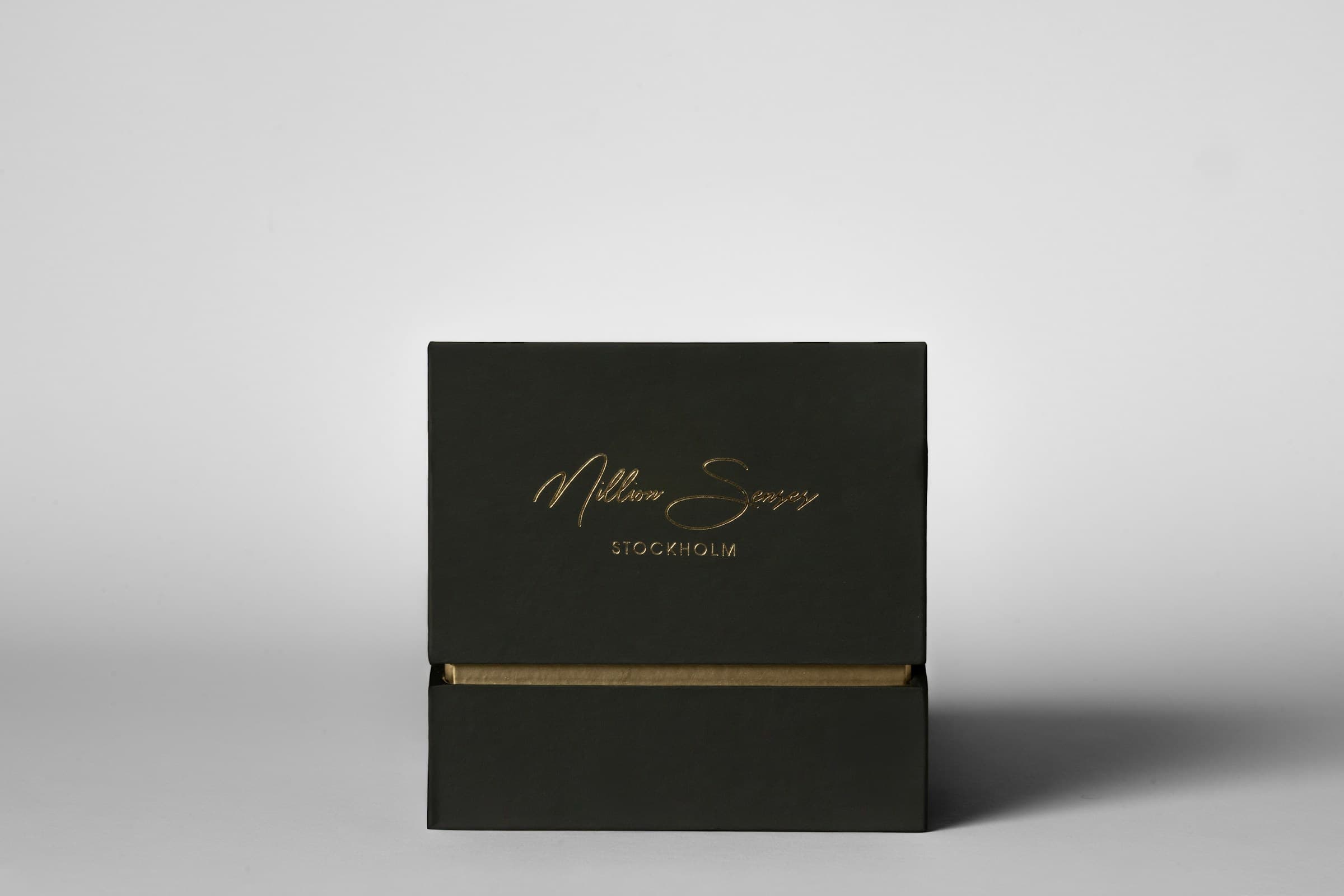
Hot-foil stamping for luxury packaging — how the press, the foil, and the substrate decide the result
By Sonia Sun, Founder, Huamei 華美 — since 1992. Updated 8 May 2026.
Hot-foil stamping is the technique that pulls metallic, pearlescent, or pigmented foil onto paper or board under heat and pressure, leaving a reflective mark that ink alone cannot produce. It is the difference between a printed gold and a gold that catches the light at three feet. Across four factories in Henan, Zhejiang, Sichuan and Guizhou, Huamei keeps seventeen foils on file in-house, run on Heidelberg and KBA offset presses with foil units, for cosmetic and skincare launches (Collgene, Kefumei and a small bench of indie houses), spirits gift packs (Wuliangye, Yangshao, Luoyang Dukang) and the seasonal ranges that brand teams build around Chinese New Year. The pages below are a working manual — what hot-foil is, how it differs from its alternatives, which foils we hold, how to pair them to a substrate, and where the technique stops working.
What hot-foil stamping is, in one paragraph
Hot-foil stamping presses a heated metal die against a foil ribbon laid on paper or board. The foil's release layer separates from its carrier and bonds to the substrate, leaving a reflective image. Press temperature 120–160 °C; dwell 0.4–0.8 s; registration tolerance ±0.1 mm.
The press has three variables and a press operator dials each one to the substrate. Temperature sets the release — too cool and the foil refuses to leave its carrier, too hot and the foil burns through. Dwell is the time the heated die stays in contact, usually four-tenths of a second to eight-tenths, and decides how cleanly the edge cuts. Pressure is the third — heavier on rough stocks, lighter on coated. The foil is mechanically bonded to the paper once it lands, which is why a hot-foiled mark survives the box's full life: rubbing, wrapping, opening, re-shelving. It is not a printed surface. It is a thin layer of metal anchored into the fibre.
This is also why ink alone cannot replace it. Anything that reads as metallic on luxury packaging is foiled, not printed. A printed gold ink can simulate the colour, but it does not carry the catch-light at the edge — the small reflective glint that happens when the buyer turns the box under a shop light.
Hot-foil vs cold foil vs digital foil
Three techniques, three different jobs.
| Technique | Ideal use | Registration | Cost shape |
|---|---|---|---|
| Hot-foil | Sharp small marks, spot accents, edges | ±0.1 mm | Tooling: dies. Per-piece: low. Best at scale. |
| Cold foil | Large flooded areas, in-line with offset | ~±0.3 mm | No die tooling; plate-based. Cheaper at low volume but visibly softer edge. |
| Digital foil | Variable / personalized data | ~±0.5 mm | Per-piece higher. Use only when each piece is genuinely different. |
The buyer-side rule is short. Use hot-foil for any logo, mark, or accent that has to read crisp at three feet. Use cold foil for backgrounds and large flooded fields where edge sharpness is not the point. Use digital foil only for variable-data work — names, numbers, individual SKUs that change piece to piece.
The seventeen foils, by optical family
The Huamei foil cabinet holds seventeen colours, in five families. We work in descriptive optical labels because the supplier SKU codes do not tell a designer what the foil will look like on stock. Names below are how they read against a cream Gmund paper at one foot.
Warm metallics — five. Champagne, rose-cast, copper, antique gold, deep gold. The warm family reads as rich against cream and uncoated stocks. It carries seasonal and gifting work. Champagne is the most-specified foil in our archive; deep gold is the strongest read for spirits.
Cool metallics — four. Silver, platinum, mirror chrome, brushed pewter. Cool metallics read as engineered against dark coated stocks. They carry skincare and grooming work. Mirror chrome is unforgiving — it shows every fingerprint — and we usually pair it with a soft-touch laminate.
Pigmented — four. Black gloss, white gloss, deep blue, deep red. A pigmented foil reads as a foil, not as ink. The difference is the edge: ink stops at the line, pigmented foil catches a faint reflective glint along it. Black gloss on uncoated cream is one of the most under-used finishes in luxury packaging.
Holographic and pearlescent — two. Rainbow, pearl. We use these sparingly. Holographic foil can read as cheap when paired wrong — never on glossy stock, never on a tight typographic mark, only on geometric shapes against dark unevenly-textured wraps.
Specialty — two. Wood-grain effect, brushed-metal effect. Used on bespoke one-offs where the brand wants a non-metallic decorative pattern that still benefits from the foil's optical depth.
A free swatch set of all seventeen — five days to post — sits behind the hot-foil topic page on every project we open.
Pairing foil to substrate
This is where most pages skip the work. The foil and the substrate are a pair, not two independent decisions, and a press operator who tries to run a champagne foil on a soft-touch laminate without changing the dwell will produce a box that flakes within a week.
Uncoated paper — Gmund, Fedrigoni, Arjowiggins. The foil reads as embedded. The substrate's tooth lets the foil sit slightly proud, which catches light. Cool metallics work especially well on uncoated stocks; warm metallics need a slightly higher dwell because the absorbent fibre soaks heat away from the foil-to-stock interface.
Coated art papers — silk, matte, gloss. Foil sits flat and reads as printed. Use this pairing for clean, modern marks on cosmetic boxes. Avoid pigmented foils on silk-coated stocks because the foil reflects unevenly and the mark looks waxy.
Book-cloth — Iris, Wibalin, Buckram. Hot-foil on cloth requires a softer die because the cloth weave compresses unevenly under pressure. Pearl and warm metallics work; pigmented foils struggle to maintain edge integrity across the woven texture.
Recycled and alt-fibre stocks — Grasshopper, Crush Citrus, hemp, bamboo. Foil bonds unpredictably. We always proof these. Some recycled stocks reject foil entirely on the first pass and require a primer coat — we will tell a buyer this on day one rather than discover it during the sample round.
The whole rule simplifies to one sentence: the substrate decides the temperature and dwell the press operator dials in. The foil is the second decision, not the first.
Registered emboss-and-foil — the house specialty
A registered emboss-and-foil is a single mark where the embossed die rises and the foil lights at the same point, in perfect alignment.
Tolerance. Held to ±0.1 mm at Huamei. The industry-typical tolerance is ±0.3 mm; the difference shows up at six inches as a slightly out-of-register foil that "shadows" the emboss.
Why it is hard. Two passes have to land on the same coordinate. Substrate moves under heat. Die wear adds drift over a five-thousand-piece run. The press operator sets a registration mark and re-checks every two-hundred sheets. The fact that we hold ±0.1 mm is a quality-management discipline, not a press capability — it is what an ISO 9001:2015-certified factory commits to and audits to.
How to spec it. Provide a single dieline showing the emboss outline AND the foil mark in one layer. Do not separate them. Specify foil colour and emboss type — sculpted (rounded, with depth detail) or flat (single-level lift). The press operator works from the unified dieline.
A house example sits in the archive. Collgene — a tuck-end carton with a registered silver-foil wordmark sitting inside a flat-emboss boundary. Pull the sample sheets and the alignment is the thing the eye reads first.
When hot-foil is not the answer
Hot-foil is the wrong tool for four jobs.
Photographic gradients. A foil cannot render mid-tones. Use a printed metallic ink instead, knowing the ink will not have the edge catch-light.
Very small fonts under six points. The foil clogs and the letterforms close up. Use embossed-only or printed-only at that size, or rework the typography until it can carry foil at eight points.
Edge-to-edge metallic surfaces over one hundred square centimetres. Use a metallized paper laminate at that size — hot-foil is unstable in large unbroken fields because the die's heat distribution becomes uneven across the surface.
Single-piece prototypes under fifty pieces. The die tooling cost dominates a run that small. Use a digital foil press for the prototype; switch to hot-foil for the production run once the design is approved.
This paragraph is the credibility moment of the page. Naming when the technique does not fit is how a buyer can tell the difference between a manufacturer who uses hot-foil and one who recommends it for everything.
Lead times, minimums, and what costs what
- Sample turnaround: seven to ten days, including the registered emboss-and-foil sample on request.
- Production: fifteen to twenty days from approved sample to crate.
- Public minimum order: two hundred pieces. Some structures run lower on a per-project quote.
- Foil swatch postage: five to seven days, free.
- Corrections: free at every stage of every project.
The cost driver on a hot-foil project is rarely the foil itself. It is the calibration time before the production run — the press operator running test sheets, dialling temperature and dwell against the specific substrate, signing off the registered alignment. That bench time is built into our quote and is why "rush" pricing on a hot-foil project usually does not produce the result a brand wants.
How Huamei runs a foil project
Five steps, in order.
- Discovery. Substrate selection, foil shortlist of three to five swatches, dieline review.
- Sample round. Physical foil dot on the actual stock, registered emboss-and-foil sample if requested.
- Approval. Sign off on the physical sample, not on the digital proof. Foil never looks like its preview because no monitor renders the catch-light.
- Production. Heidelberg or KBA press run, hand-assembly under the QC inspector who signed off the sample.
- Crate, ship. From the press floor to the buyer's hand, with the same crate seal.
For the broader sourcing context — how to brief a Chinese luxury packaging manufacturer, what to expect on a factory call, how to think about lead times when a project is overseas — read working with a Chinese luxury packaging manufacturer. For where hot-foil sits inside a complete rigid-box build, read custom luxury rigid box manufacturing.
Specify what the box should say in foil. We will show what it can be.